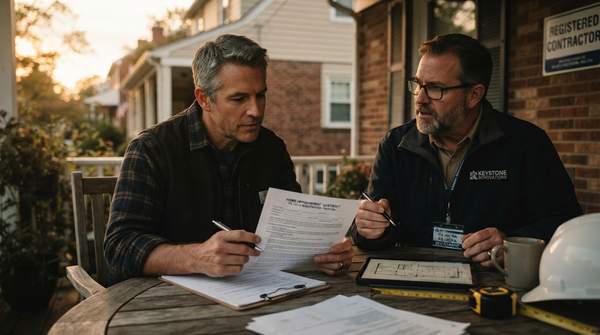
Before you sign anything, Pennsylvania gives you one decisive test: does your contractor hold an active registration with the Attorney General's Office under the Home Improvement Consumer Protection Act? Since the law took effect on July 1, 2009, most contractors performing at least $5,000 worth of home improvements per year must register, carry minimum insurance, and use contracts that meet consumer protection requirements. This guide walks you through what the law covers, what it entitles you to, and how to verify a contractor before you commit.
Understanding Pennsylvania's HICPA: Your Foundation for Protection
The Home Improvement Consumer Protection Act was passed by the Pennsylvania Legislature in 2008 and took effect the following summer, as the state's Department of Labor and Industry explains. It requires most home improvement contractors to register with the Pennsylvania Attorney General's Office, maintain minimum insurance coverage, and use contracts that comply with the consumer protection requirements written into the law. Enforcement falls to the Attorney General's Bureau of Consumer Protection.
The registration threshold is annual, not per project. According to the Attorney General's Office, any contractor who performs at least $5,000 worth of home improvements per year must register. The scope is broad: a legal guide for contractors notes that anyone who owns or operates a home improvement business, or who offers, performs, or agrees to perform home improvements in Pennsylvania, must register unless specifically exempted under the act. Contractors pay a $100 registration fee every two years under a change to the Commonwealth Fiscal Code.
One point deserves emphasis, because it shapes every step that follows: Pennsylvania does not impose general licensing or certification on most construction contractors, as the state's Department of Labor and Industry confirms. HICPA registration is a registration program, not a trade-skills test. The Attorney General's Office states plainly that registration is not an endorsement, recommendation, or approval of a contractor's competency or skill.
Key Protections HICPA Offers Homeowners
HICPA pairs its registration program with concrete contract requirements. As the construction-payment resource Levelset explains, the act establishes required contract provisions and minimum insurance coverage alongside the registration system itself. That means your written agreement is not just paperwork—it is the instrument through which the law's protections operate.
For a home improvement contract over $500, the agreement must be in writing and include specific provisions: the contractor's details, a description of the work, the total price, and start and completion dates. The contract must also include a Notice of Rescission, which gives you a window to cancel the agreement after signing. When you review a proposed contract, treat these elements as non-negotiable minimums under the law, not as courtesies the contractor is extending.
Insurance is the other pillar. Registered contractors must maintain minimum liability coverage—at least $50,000, according to guidance on Pennsylvania contractor registration. That figure is a floor, not a guarantee of full protection for a major renovation, but it establishes a baseline of financial accountability that an unregistered operator simply does not have. Ask for proof of current coverage rather than accepting a verbal assurance.
Step-by-Step: Vetting Your Contractor Under HICPA
The practical power of HICPA lies in verification. The Attorney General's Office maintains an online tool to verify a contractor's HICPA registration, and the Bureau of Consumer Protection can answer registration inquiries directly. Because registration is the legal gateway to the act's contract and insurance requirements, confirming it is your first move—before you discuss materials, timelines, or price.
Keep the limits of the check in view. Passing the registration lookup tells you the contractor is in the state's system and subject to HICPA's obligations; it tells you nothing about craftsmanship. A contractor's registration number also does not cover every job they might bid. Specialized trades can require separate credentials, and your city may have its own local requirements on top of the state registration—an electrician working in Philadelphia faces different licensing rules than a cabinet installer in a suburban kitchen. This article covers only the state-level HICPA registration, not municipal requirements that may also apply.
Navigating Subcontractors and HICPA
Subcontractors are a common blind spot. Guidance on Pennsylvania contractor registration is direct on the question: subcontractors performing covered home improvement work who meet the registration requirements need their own HICPA registration, and a general contractor's number does not cover them. If a kitchen remodel brings in a separate flooring business, that flooring business may need its own registration even though the general contractor holds the homeowner contract and handles billing.
What does this mean for you as a homeowner? Your direct contractual relationship—and therefore your vetting obligation—runs to the contractor you actually hire. The Attorney General includes subcontractors and independent contractors in its registration guidance, and contractors are advised to check a sub's registration before bringing them onto covered work. If you ever contract directly with a specialist for home improvement work, that specialist becomes the contractor you must verify, with the same registration lookup you would run for a general contractor.
Your Pennsylvania HICPA Contractor Vetting Checklist
Work through these steps in order before signing. Each one is anchored to a specific requirement of Pennsylvania law, and together they produce a clear go/no-go decision on whether a contractor meets the state's minimum legal requirements to perform home improvement work.
- Confirm the law applies to your project. HICPA covers contractors performing at least $5,000 in home improvements per year, and its written-contract requirements apply to contracts over $500. If your project is smaller, the registration check still matters for any established business.
- Verify the registration. Use the Attorney General's Office online verification tool to confirm the contractor's active HICPA registration. You can also call the Bureau of Consumer Protection at 1-888-520-6680 with registration inquiries. No active registration is a no-go.
- Ask for proof of liability insurance. Registered contractors must carry at least $50,000 in liability coverage. Request current documentation rather than a verbal confirmation.
- Review the contract for HICPA compliance. For work over $500, confirm the agreement is written and includes the contractor's details, a description of the work, the total price, start and completion dates, and a Notice of Rescission.
- Check any specialist you hire directly. If you contract directly with a trade business for covered work, run the same registration check on that business—a general contractor's number does not extend to it.
- Remember what registration is not. The Attorney General's Office does not endorse a registrant's competency or skill, and local licensing rules may still apply. Registration clears the legal bar; references, reviews, and local permit requirements are separate judgments.
Making Your Informed Decision: Proceeding with Confidence
Proceed with a home improvement contractor only after confirming their active HICPA registration, adequate liability insurance, and a contract that fully complies with HICPA requirements. The measurable indicator of readiness is concrete: contractor's active HICPA registration, proof of liability insurance, and a contract complying with HICPA requirements. When all three are in hand, you have done what Pennsylvania law allows you to do—this guide is informational and does not constitute legal advice, and it does not evaluate any contractor's skill or reputation. What remains is the work itself, begun on a foundation the law actually protects.
Sources
- Home Improvement Contractor Registration - PA Office of Attorney General
- Contractor Licensing — PA
- \r\n \n PA Home Improvement Contractor License: A Guide\n \r\n — Cozzalaw
- Pennsylvania Contractor License & HIC Registration (2026) — Cinderblock
- Pennsylvania Home Improvement Consumer Protection Act: What Residential Contractors Need to Know — Levelset