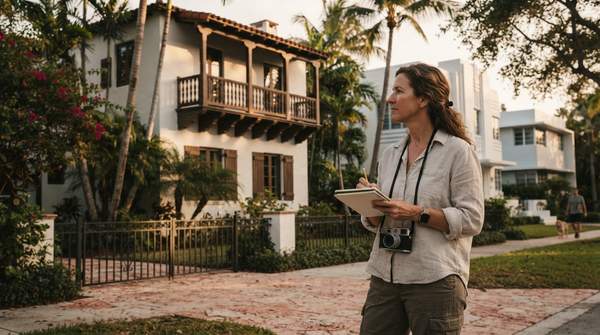
Palm Beach residents can learn to read their streetscape with a handful of visual clues. Three styles in particular — Monterey, Art Deco, and International Style — represent distinct chapters in the town's residential history, and each announces itself through ornamentation, form, and window treatment. Monterey homes, the most locally rooted of the three, wear a second-story balcony over simple roof forms and bare walls; Art Deco houses favor hard-edged geometric relief and a vertical push; International Style houses strip ornament away entirely in favor of flat roofs, smooth glass-and-metal surfaces, and asymmetry.
Understanding Palm Beach's Architectural Heritage
For a town famous for its grand estates, some of Palm Beach's most telling residential architecture is modest. The Preservation Foundation of Palm Beach has highlighted this with its exhibition "The Third Era of Design: Architectural Trends in Post-Depression Palm Beach," on display from January 2026 to May 2026. The exhibit explores what the Foundation describes as a pivotal moment in American architectural and cultural history, "when affordability, style, and patriotism converged in the design of the Palm Beach home."
That framing matters for identification. When a resident walks past a 1930s or 1940s house in town, they are often looking at a deliberate interpretation of a national movement toward modest, well-designed housing rather than at a purely local invention. The styles covered here — Monterey, Art Deco, and International Style — are the same styles that preservation and transportation agencies use to classify historic Florida residences, so learning their features gives residents a shared vocabulary with the official record.
This guide covers a selection of common historical residential styles, not an exhaustive survey, and it addresses private houses rather than commercial or civic buildings. It is intended for identification and appreciation, not for navigating historic-preservation regulations or planning a renovation.